Managing Risk: Building Resilience into Your Startup

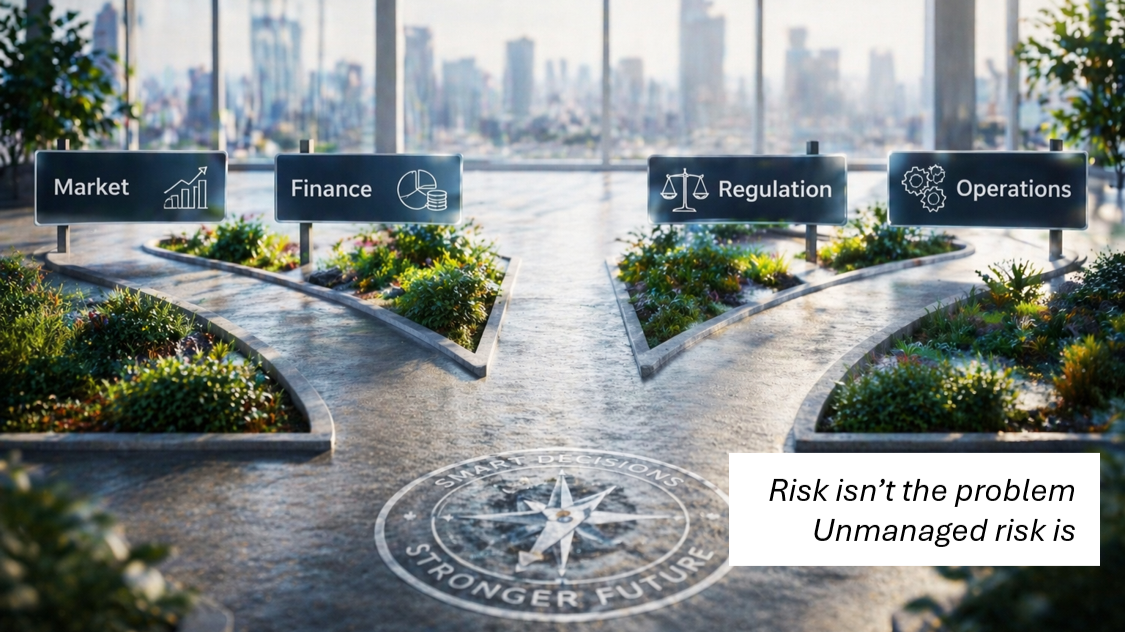
Why Risk Isn’t Something to Avoid; It’s Something to Manage
Startups are built on taking risks. New ideas, new markets, new ways of doing things. But while risk is inherent in every startup, how you manage it determines whether you scale or stall.
Too often, risk is treated as something to deal with later, after funding, after product-market fit, after growth. In reality, risk management is not a constraint on growth. It’s what enables it and often accelerates it.
This post explores how startups can approach risk in a practical, structured way without slowing down.
Why Risk Management Matters Early
In the early stages, many risks are invisible or underestimated. Decisions are made quickly, often with limited data. That’s part of the startup model. But unmanaged risk tends to show up later and often at the worst possible time:
- During due diligence
- When raising capital
- When scaling into new markets
- Or when something goes wrong
The goal isn’t to remove risk. It’s to understand it, prioritise it, and make better decisions because of it.
The Types of Risk Startups Face
Not all risks are equal. A simple way to think about it is across five key areas:
- Strategic Risk - Are you solving the right problem? Is the market real?
- Financial Risk - Do you understand your runway, burn rate, and funding needs?
- Operational Risk - Can your systems, processes, and team scale effectively?
- Regulatory Risk - Are you compliant with laws and industry requirements?
- Reputational Risk - How would a misstep impact trust with customers, investors, or partners?
You don’t need complex models but you do need visibility across these areas.
Common Risk Blind Spots
Startups often fall into a few predictable traps:
- Over-reliance on founder instinct without challenge or validation
- Ignoring low-probability risks that carry high impact
- Lack of documentation, making issues harder to trace or fix
- No clear ownership of risk across the team
- Reactive decision-making instead of proactive planning
These aren’t failures, they’re signals that structure is needed.
Practical Ways to Manage Risk Without Slowing Down
1. Keep a Simple Risk Register - List your top 5–10 risks. For each, note likelihood, impact, and what you’re doing about it. Keep it visible and review it regularly.
2. Prioritise What Matters Most - Not all risks need action. Focus on those that are high impact and high likelihood. That’s where governance adds value.
3. Assign Clear Ownership - Every key risk should have an owner. Not a team but a person. Accountability drives action.
4. Use Your Board and Advisors - Risk should be a standing agenda item in governance discussions. External perspectives often surface risks founders don’t see.
5. Build Risk into Decision-Making - Before major decisions, ask:
- What could go wrong?
- What’s the downside?
- What’s our mitigation plan?
This doesn’t slow decisions, it improves them.
Final Thoughts: Risk as a Discipline, Not a Barrier
Startups that succeed aren’t the ones that avoid risk. They’re the ones that engage with it deliberately.
Good governance doesn’t eliminate uncertainty. But it gives you the tools to navigate it with confidence.
In a fast-moving environment, resilience becomes a competitive advantage and that starts with how you think about risk.
What’s one risk your startup underestimated and what did you learn from it?
#StartupGovernance #RiskManagement #Entrepreneurship #Scaling